
Much of today’s discussion about agentic commerce focuses on whether shopping will move from e-commerce websites into interfaces such as ChatGPT.
But in consumer commerce, much of the buying journey has already been solved reasonably well by the browse-and-click paradigm. Comparing options was the last remaining bottleneck that ChatGPT now, often, solves better than the traditional listing search engine.
B2B procurement is different. Much of the buying journey has never been effectively digitized because the work cannot be reduced to browsing a catalogue and clicking through a predetermined route.
Agents are unusually well suited to overcoming the bottlenecks that have kept B2B procurement excessively manual, despite an abundance of (clunky) software.
It’s not just the buying journey that gets transformed, though. As agents get into comparing options and negotiating inside the workflow, the decision architecture across the firm changes as well.
Less obvious, but likely more consequential, are the many competitive games agents introduce between:
The company deploying the agents and the providers providing them
Adjacent workflows and decision makers across the firm rewiring its workflow
Players ranging from corporate payments providers to systems of record as every player tries to go AI-enabled and launches its own procurement agents
Negotiation games between buyer-side agents and seller-side agents
All of this opens a bunch of fascinating questions about how agents transform workflows, the nature of the firm, and the nature of competition in the ecosystem. This was very much the central argument of my book Reshuffle - that AI transforms not just how the task is performed but how entire economic systems are coordinated.
Today, I’m launching a new series of initiatives to track and map out how the ideas I first presented in Reshuffle are playing out across different domains.
I’m thrilled to announce a full redesign of the Reshuffle website, structured around the book and the new research to track how these ideas are playing out.
Why I’m building the Agentic AI Observatory
Much of the current hype around agent autonomy looks for change in the wrong place.
We ask whether agents are autonomous, whether humans remain in the loop, or how many tasks have been automated. But these questions miss the more important changes that are already transforming the system.
An agent can determine which options are considered, how those options are negotiated to meet a workflow’s requirements (often the more consequential effect of autonomy), what information is eventually shown to an approver, and which actions are executed - while a person managing the role makes the final decision.
On paper, control has not moved. It’s time to celebrate the ‘human-in-the-loop’.
In practice, the path to the outcome may already have been redesigned.
This is what I hope to track with the Agentic Procurement Observatory - the first domain I examine in the Agentic AI Observatory. This will be followed by six other observatories - each on workflows that are likely to show unique structural effects owing to the deployment of agents.
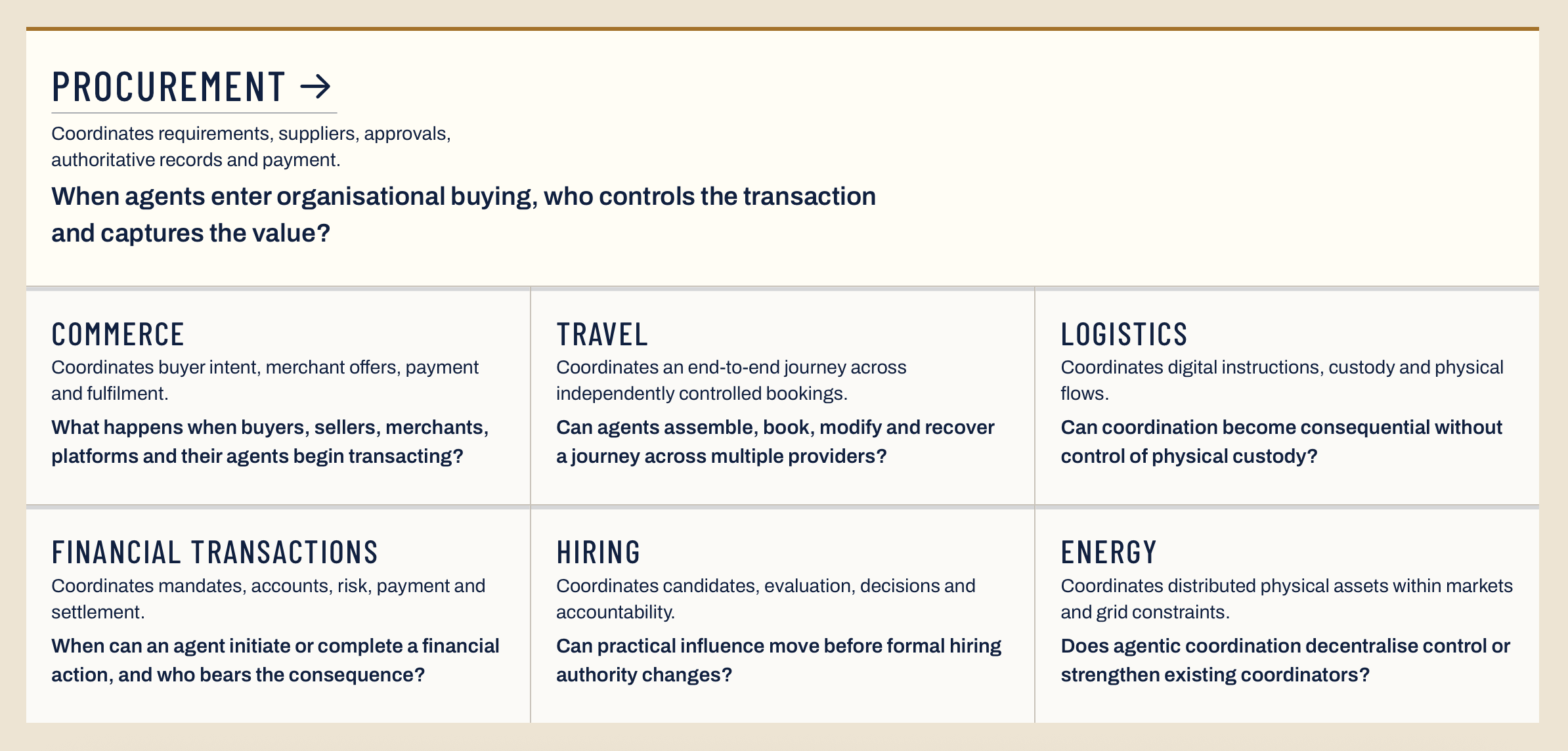
Read the thesis on each domain here.
The case for agentic procurement
There are two factors that make B2B procurement a ripe candidate for agentic reshuffling.
First, B2B procurement is largely an exercise in constraint-based buying.
A purchase must satisfy a changing combination of requirements set by the buyer: technical specs, budget limits, policies, approved suppliers, contractual terms, delivery conditions, and other rules and preferences. These constraints often emerge gradually, conflict with one another, or vary from one transaction to the next.
Second, it is also an exercise in quote construction.
The buyer is not always choosing among finished products at posted prices. Buyers and suppliers frequently construct the offer together, engaging in a back-and-forth to configure scope, quantities, service levels, commercial terms, implementation obligations, and exceptions until a viable transaction emerges.
Traditional procurement software has struggled with both activities. It is generally designed to manage buying based on predefined forms and workflows. It works well when the options and rules are fully known in advance. It works much less well when the system must interpret an incomplete request, gather context, resolve competing constraints, coordinate several parties, or construct a transaction iteratively.
Activities have stayed manual not because there is something special about human involvement but only because they are contextual, negotiated, and constraint-heavy.
Agents are unusually well suited to this problem. They can work with unstructured information and discover missing requirements. They can also maintain context across interactions, reconcile constraints, generate alternatives, and coordinate the construction of a quote in real time. Instead of forcing every purchase into a fixed workflow, an agent can help assemble the required workflow around the purchase.
This makes procurement a domain in which agents may organize work in a way that the previous software paradigm simply could not. Agents may finally make previously unprogrammable parts of business buying programmable.
The Agentic Procurement Observatory
Agents can enter the buying journey at every stage, but their presence alone tells us very little about how power is changing.
The Observatory therefore looks at the second-order effects.
The Observatory follows agents through the buying system: where they have a structural advantage, where they are demonstrably acting, how far their actions reach, who makes the resulting outcome binding, whether organizations are redesigning around them, and what new competitive mechanisms may be forming.
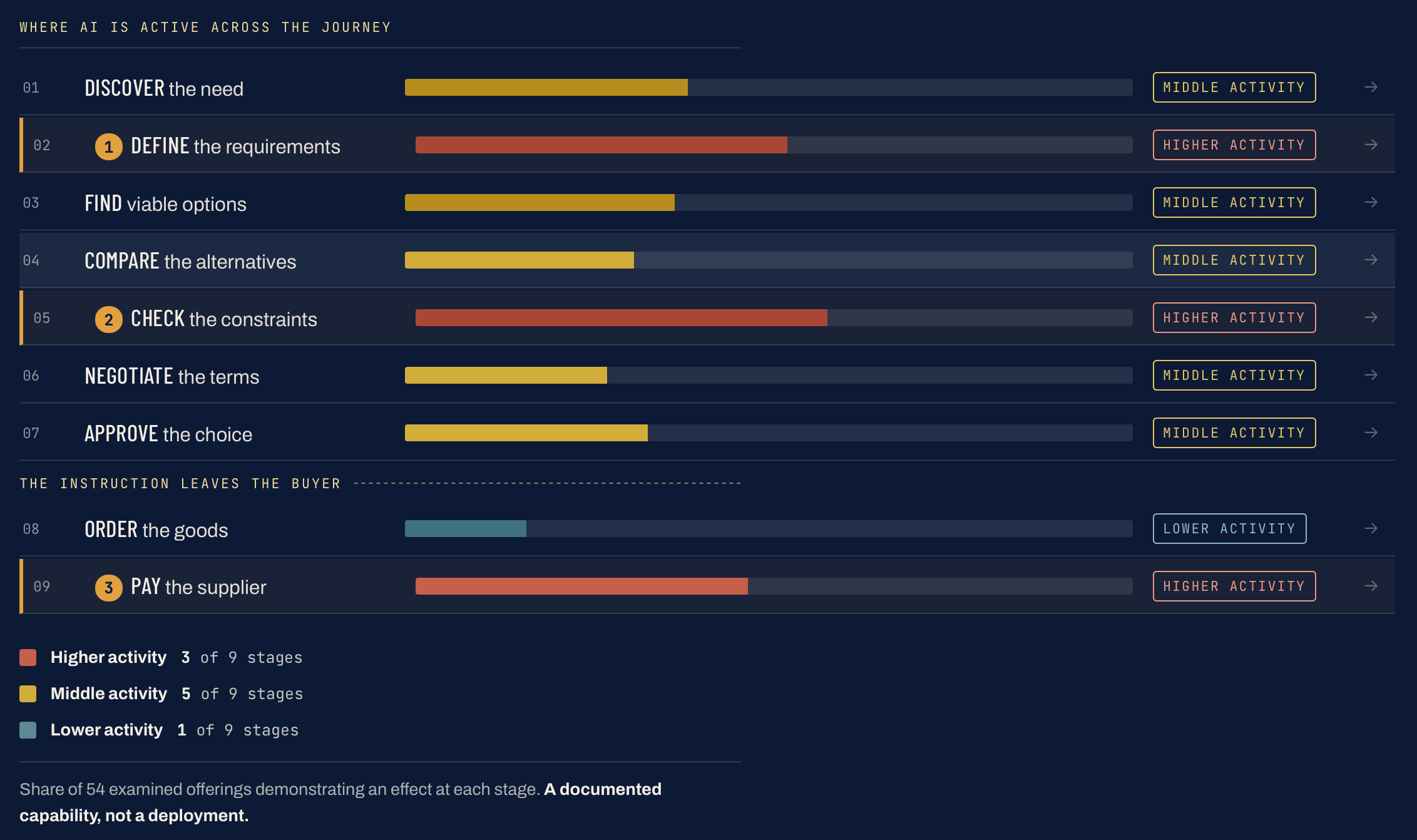
Agents prepare, shape, constrain, execute, and sometimes enforce consequential parts of the workflow. A human may retain final approval while an agent determines which options are presented, which risks are surfaced, or which pre-existing authority is invoked during a negotiation. The final click may remain with a human, even as power over the choice increasingly shifts to the tool provider.
This dynamic is particularly visible in Ramp’s expansion from corporate cards into procurement.
Ramp enters the transaction from an adjacent control point: it already sees the request for spend, understands the company’s policies, controls access to payment, and records what was ultimately purchased.
From that position, it can move upstream across the procurement workflow and influence supplier selection before the payment ever occurs.
This points to a broader competitive shift that is also revealed through the data.
In an agentic market, companies do not need to attack an incumbent’s product directly. They can enter from a neighbouring workflow, use their existing data and control position to absorb adjacent decisions, and gradually redefine where the category begins and ends.
The visual below (interactive on the site) illustrates various entry points through which players enter the procurement worflow and expand their influence across it.
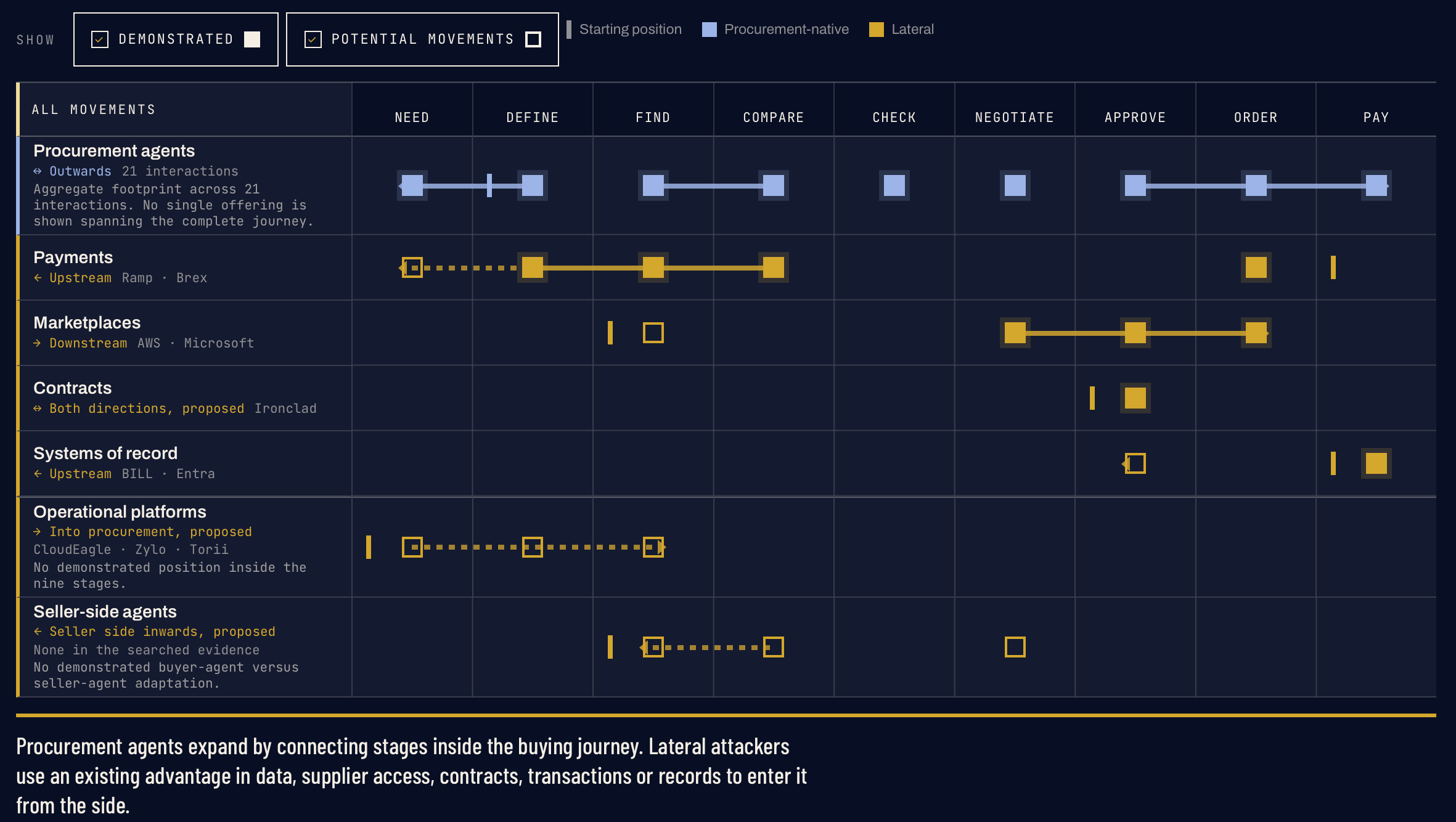
This lateral competition - competition between providers that originate in different categories but converge on the same consequential decision - is a hallmark of agentic competition.
A corporate-card company, procurement platform, expense-management provider, ERP, marketplace, or contract-management system may all approach the buying decision from different starting points. Once agents can carry context and coordinate actions across workflow boundaries, each can attempt to become the layer through which the transaction is interpreted, constructed, and controlled.
As a result, procurement software is no longer the well-defined Saas category that it used to be. It is about which provider can use its existing position to become the environment in which buying decisions are made.
The Observatory examines these dynamics through multiple connected lenses: agentic pressure across the buying journey, depth of work transformation, alternative workflow configurations, evidence of operating-model movement, emerging market mechanisms and scenarios for how power could shift.
These effects are analyzed at three levels:
The Observatory distinguishes agents from configured rules and conventional automation. It separates observed actions from product claims. It records counterexamples and missing evidence alongside positive findings. And it traces each conclusion back to the concepts and theoretical foundations in the wider Reshuffle knowledge graph.
The Observatory is the first empirical expression of the Reshuffle knowledge graph, with many more to follow.
If you’re intrigued by this research, or would like to build custom research instruments like this one, feel free to write back.
And keep an eye out for more launches in the weeks ahead.
Quote construction needs a visible list of unresolved choices. Otherwise an agent can reconcile competing requirements by silently changing the scope, leaving both sides looking at a plausible but different offer.
The final click stayed human while everything before it changed species