
Scarcity and strategy - Misreading AI the way Hollywood misread streaming
A summer full of strategy

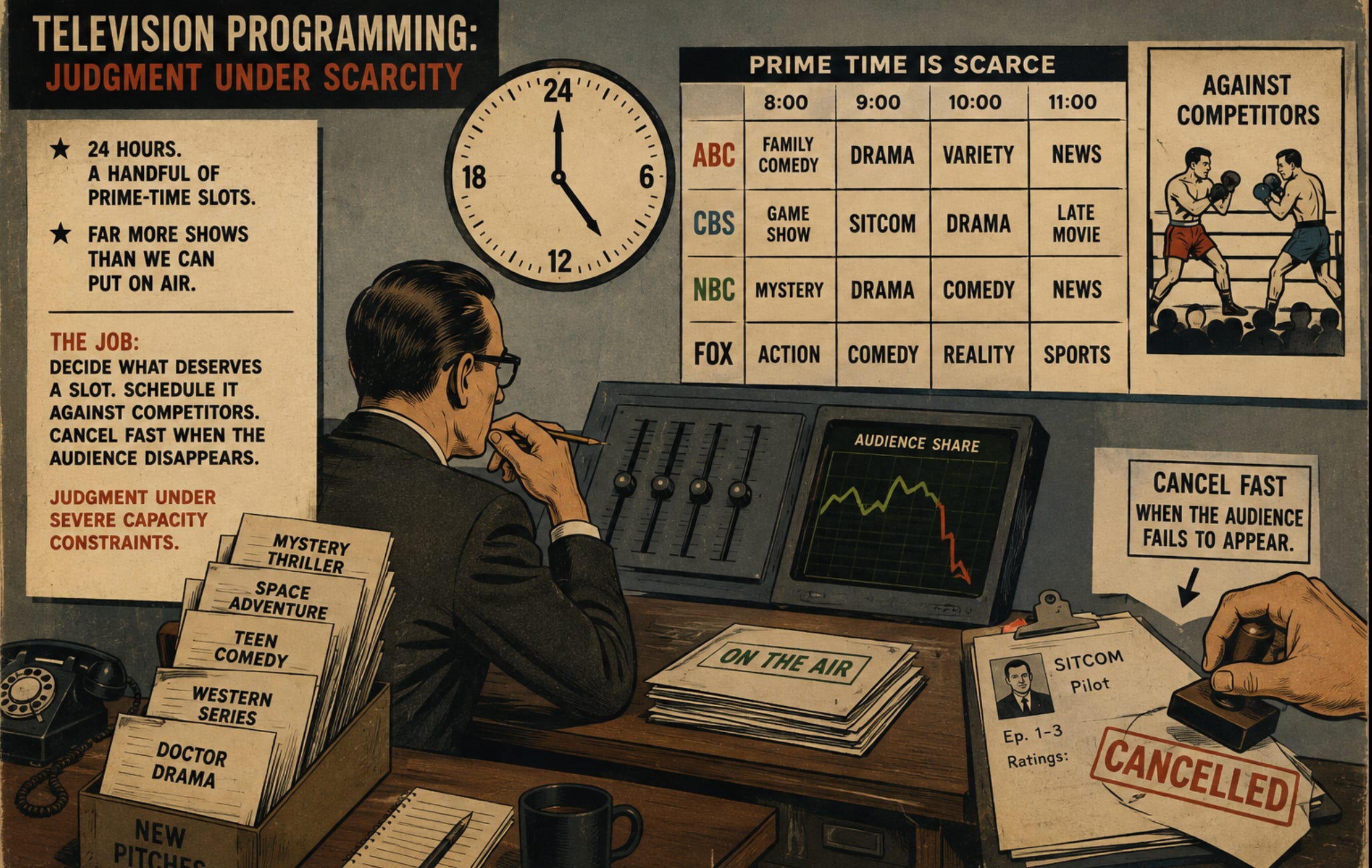
Traditional TV programming was built around a scarce asset - prime-time slots.
A network had twenty-four hours in a day, a handful of prime-time slots, and far more shows than it could have on air. The programmer’s job was therefore to decide what deserved one of those scarce slots, schedule it against competitors, and cancel quickly when the audience failed to appear. It was a case of exercising judgment under severe capacity constraints.
We often think that Netflix made access to content abundant.
But the real scarcity it removed was the scarcity of the prime time slot.
Streaming effectively removed the TV programming grid. There was no Thursday at 9 p.m. to win, no fixed shelf space to allocate, and far less reason to make every show appeal to a mass audience. Thousands of titles could coexist and viewers could consume them whenever they wanted.
The new game - The Streaming Reshuffle
Your average case study on Netflix will talk about the abundance of content and access, thanks to streaming.
However, removing programming-slot scarcity changed a lot more than distribution and access. It changed the structure of the industry behind the distribution pipeline.
Under broadcast scarcity, every show had to justify occupying one of a tiny number of slots. That pushed the industry toward broad appeal, predictable formats, recognizable stars, familiar genres, and concepts that could be explained quickly to advertisers and network executives. With shows competing to access a scarce scheduling slot, programming was much more conservative.
Once streaming removed the fixed grid, the viability threshold changed. A series no longer had to attract 15 million people on the same night. It could be valuable by attracting a smaller, highly specific audience over a longer period. That opened the door to narrower genres and serialized storytelling. It also allowed experimentation with darker themes, niche documentaries, and projects that would have looked too small or too strange for prime-time television.
It also changed who could be backed and transformed the careers of actors like Bobby Deol and Winona Ryder. In the old system, stars mattered partly because scarce slots made failure very expensive. If you only had a handful of bets, you wanted proven actors, proven showrunners, proven formats. Under abundance, platforms could make more bets and tolerate a longer tail of outcomes.
Broadcast television was organized around national markets because spectrum, advertising, scheduling, and distribution were national. Streaming made this market international. Squid Game, for instance, did not need to be designed as global television in order to become globally important.
Broadcast schedules rewarded self-contained episodes because viewers might miss one week, arrive halfway through a season, or encounter reruns out of order. On-demand viewing made long-form serialization much easier. Writers could assume continuity. Episodes no longer had to fit rigid 22- or 44-minute advertising structures. Seasons could be six episodes or ten rather than twenty-two. The unit of creative design could shift from the episode toward the season - or even the complete narrative arc.
It also changed how portfolios were managed. A broadcaster had to decide ex ante which few programs deserved scarce airtime. A streaming platform could commission a much larger portfolio and then learn from actual behavior: who starts a show, who finishes it, what audiences overlap, which markets respond, what gets rewatched, what drives retention. Programming therefore moves from something closer to editorial capital allocation under scarcity toward portfolio experimentation under abundance.
This, in turn, changed the power structure around talent. Under the old model, the network controlled the scarce distribution slot, so creators needed access to the network. Under streaming, platforms initially created much greater demand for producers, actors, writers, and showrunners because they needed huge volumes of differentiated content. Scarcity temporarily migrated toward high-quality creative talent and distinctive IP. That is one reason the streaming wars produced extraordinary bidding for creators and content libraries.
Removing one bottleneck does not merely improve the old industry.
It changes which projects are economically viable, which actors have bargaining power, what organizational capabilities matter, and ultimately what the industry is optimizing for.
This is why technological transitions are so often misread. We ask how the new technology will improve the existing game: how streaming improves content access for consumers, how the internet improves retail, how AI improves knowledge work. We focus only on the job to be done.
The more important question is what happens after the old constraint disappears.
Because strategy is ultimately organized around scarcity. And when technology changes what is scarce, it changes where power, advantage and value can accumulate.
Hollywood initially misread streaming as a new distribution channel for the same old product. What it missed was that streaming removed the scarcity of schedule, which changed the game itself.
Many companies are making the same mistake with AI today. They are treating it as a productivity layer for the existing firm, while missing that the real game shifts elsewhere.
Scarcity and Strategy
One of the central ideas in my book Reshuffle is the relationship between scarcity and strategy.
Every generation of strategy is built around managing what is scarce.
When productive capacity was scarce, advantage came from owning productive assets. When distribution was scarce, advantage came from controlling channels. When attention and market coordination became scarce, platforms won by aggregating participants and setting the rules of exchange.
Reshuffle argues that AI is now removing scarcities around the production of usable knowledge work.
That is why so much of today’s strategy debate feels slightly off. We keep asking whether AI will automate jobs or lower costs - but these questions assume that companies will continue to play the old game.
What matters more is what becomes scarce once usable knowledge work can be accessed cheaply.
(Note that I constantly use the phrase ‘usable knowledge work’, not intelligence. The latter, as I call out in the introduction to Reshuffle, is a distraction unless it delivers the former.)
The history of strategy can be read as a history of migrating bottlenecks.
And the companies that get disrupted are often not the ones that fail to adopt the new technology. They are the ones that continue optimizing a game structured around managing a previously scarce asset that has suddenly become abundant.
Misdiagnosing scarcity
Even once we decide that we need to move to the new scarcity, it is easy to misdiagnose what’s really changing.
It’s easy to claim today that AI will make knowledge work abundant. But knowledge work is too broad a category, just as content was too broad a category for understanding streaming.
What really matters is diagnosing the specific scarcity inside the usable knowledge-work-production system that AI is removing.
Much of the knowledge economy has been organized around the high cost of exploration. Serious analysis required scarce expert time, so organizations had to ration which questions deserved investigation before they knew which questions would prove valuable. Managers considered a few hypotheses, few alternatives, and few courses of action.
AI begins to remove that scarcity. It makes it possible to generate, simulate and recombine vastly more candidate explanations and courses of action before committing significant resources to any one of them.
This changes the game in three vastly different ways.
Direction 1: Judgment becomes more valuable because selection becomes the bottleneck
One view suggests that if AI can generate 100 plausible strategies instead of five, the strategist’s value moves away from producing options and toward deciding which ones deserve belief and commitment.
On this view, AI commoditizes production but strengthens the value of judgment. The scarce resource becomes the ability to distinguish signal from seemingly plausible noise.
The problem with this argument is that it traps us in our old arguments of human exceptionalism. If AI can generate alternatives, it can also rank them, criticize them, run adversarial checks, compare them against evidence, and learn which recommendations worked.
What looks like a permanent human bottleneck may merely be the next temporary inefficiency.
And organizations banking on this would simply be banking on an inefficiency arbitrage much like the prompt engineers of 2024 did.
Direction 2: Judgment becomes less important because experimentation replaces prediction
When exploration was expensive, organizations had to make strong ex ante judgments. An executive had to decide which three product concepts deserved testing because testing thirty was impossible.
As exploration becomes cheap, the organization can postpone judgment. It can generate many possibilities, test them cheaply, observe what happens, and progressively allocate resources toward those that survive.
The game therefore moves from upfront prediction to emergence through experimentation.
This is close to what happened when television moved from scarce programming slots to streaming. Network executives once had to decide in advance which few shows deserved scarce airtime. Once distribution became abundant, more bets could be placed and audience behavior could do more of the selecting.
Applied to knowledge work, the implication is unsettling. The future strategist may not be the person with the best judgment about which answer is right. The advantage may belong to the organization that can structure the cheapest and fastest learning process for discovering what is right - even if they entered your industry with much lower expertise.
If the cost of experimentation collapses sufficiently, the value of judgment collapses with it.
Of course, much of business cannot simply be A/B tested. Acquisitions, reputation, organizational restructurings and geopolitical bets often involve irreversible commitments. But wherever experimentation can reduce uncertainty, it allows the creation of a fundamentally different form of competitor.
Direction 3: The real scarcity becomes framing because abundance expands the search space faster than our ability to navigate it
There is a third possibility.
Cheap exploration does not necessarily make decision-making easier. It may make the search space explode.
When five hypotheses can be examined, deciding among them is manageable. When five thousand can be generated, the problem becomes defining which possibilities belong in the search space at all.
The scarce capability therefore moves further upstream, from producing answers to constructing the framework within which answers are generated.
What problem are we actually solving? Which variables belong in the model? Which causal relationships matter? Which evidence would change our mind? Which outcomes are we optimizing for? Which constraints are real and which are inherited from the old system?
AI can generate thousands of answers to the wrong question at negligible cost. Abundance therefore increases the value of a good lens.
The scarce asset is the learning architecture
These three arguments look contradictory because each places scarcity at a different point.
The first says scarcity moves downstream into judgment.
The second says judgment itself can be displaced by experimentation.
The third says scarcity moves upstream into framing.
The resolution is that none of those activities is independently the new source of advantage.
The scarce capability is the architecture that connects them.
An AI-native organization needs to frame the right search space, generate many possibilities within it, cheaply eliminate weak ones, test the promising ones against reality, determine where irreversible commitment is justified and then feed the results back into the next round of search.
The advantage is created through a superior learning architecture spanning possibility to evidence to commitment.
Strategy in a world of expensive exploration is largely the discipline of making good choices with limited analysis.
Strategy in a world of abundant exploration becomes the discipline of designing systems that search broadly, learn cheaply, and commit selectively.
If you’ve enjoyed reading this post, dig furtehr into the ideas in Reshuffle:
Still the best! Keep them coming! It's been a while...
Great insights, Sangeet! As always, you are opening our minds to new ideas. For me, this helps me tell a better story of why AI pilots are so important, as long as they are shorter time frames and we document what worked and didn't so that we can learn for the next ones. Unfortunately, other people are telling organizations to stop running pilots because they waste time. You are helping us prove why that is not true.