
The Jevons Misunderstanding
Stop saying Jevons Paradox to get to simplistic, reassuring answers

If I had a token for every time someone said Jevons Paradox, I’d have enough compute to explain why Jevons Paradox doesn’t explain what they think it explains.
There are many convenient explanations people reach for when they want to make sense of AI. One of them is Jevons Paradox.
As the AI doomers began warning that AI would take away all jobs, the other side reached for Jevons:
Efficiency expands demand;
Cheaper work creates more work;
Therefore, workers will be fine.
The problem with this binary debate is that it leaves no room for the actual economics. You are forced into one of two camps: AI destroys jobs, or AI creates more work.
But the real question is neither whether the market grows nor whether work disappears. The real question is who benefits from the demand expansion.
That is the Jevons Misunderstanding!
The Jevons Misunderstanding
The Jevons Misunderstanding - applying Jevons Paradox as a counter to all AI doomerism - mistakes augmentation for complementarity.
Augmentation - whether AI helps the worker perform the task - is irrelevant.
What matters is whether AI increases the worker’s claim on the new surplus generated.
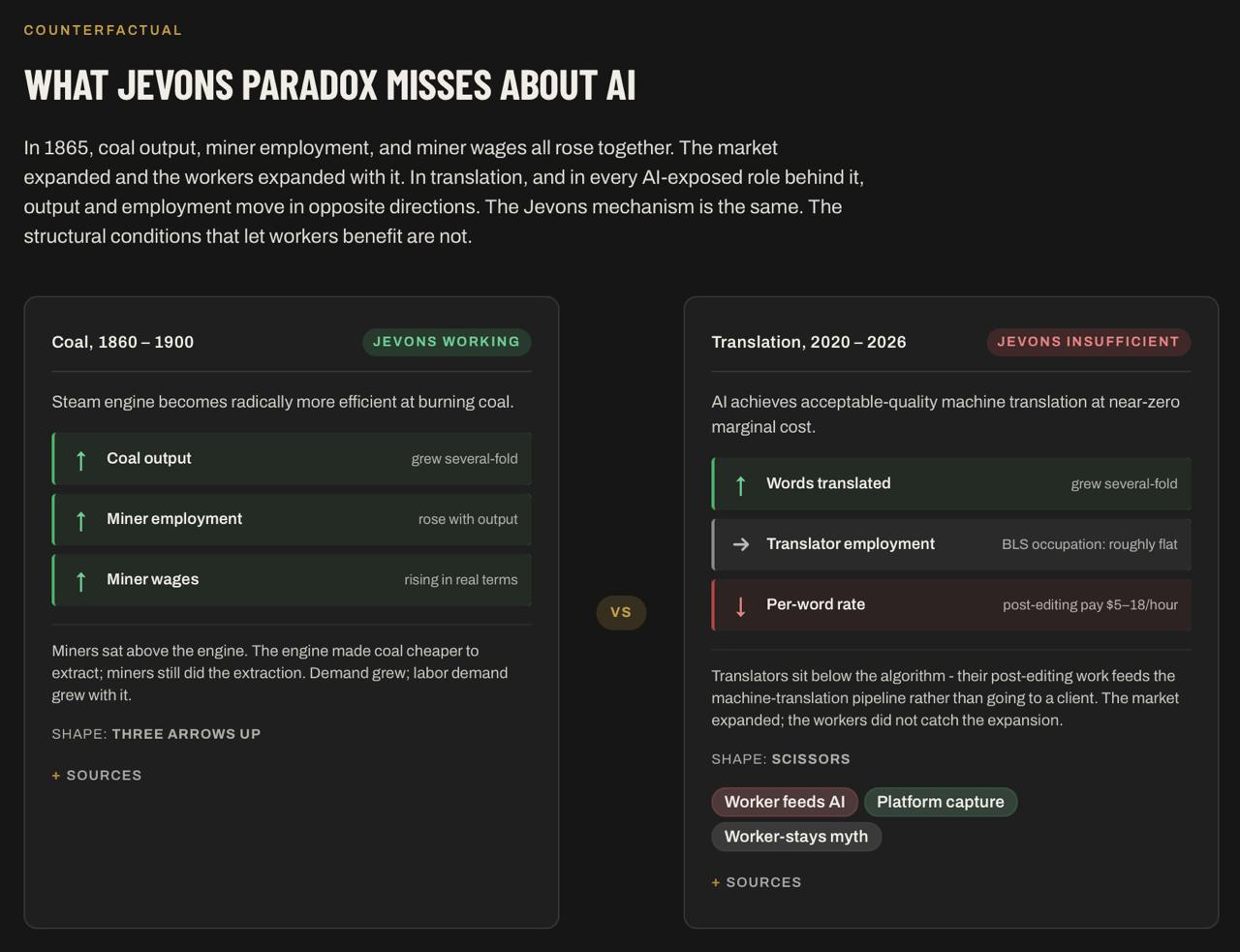
The Jevons Misunderstanding assumes the old production system continues to scale when demand expands as a result of the new technology.
That was more plausible in earlier industrial cases where efficiency made the existing resource economy larger.
AI is different because it can re-architect the production system itself. It:
1. Separates the worker from the customer,
2. Turns the augmented worker’s continued expertise into raw material for training,
3. Codifies craft by progressively unbundling previously tacit knowledge into components that can be absorbed by the tool.
Expansion no longer has to pass through the old labor bundle. It can bypass it - meaning the worker stays employed but at progressively lower wages in worse conditions, not seeing the benefits of the market expansion.
That is what the Jevons debate misses. The issue is not whether AI expands demand. It often will. The issue is whether workers sit above the algorithm, using AI as leverage, or below the algorithm, feeding the system that captures the value.
An alternate format
Instead of provising the persuasive argument alone, as I’d do in most newsletters, I’m going to take another path here.
Trace the argument, but you’re also invited to play around with some data around the argument.
For instance, this divergence in demand and wages across 6 jobs that shows Jevons Misunderstanding play out at scale:
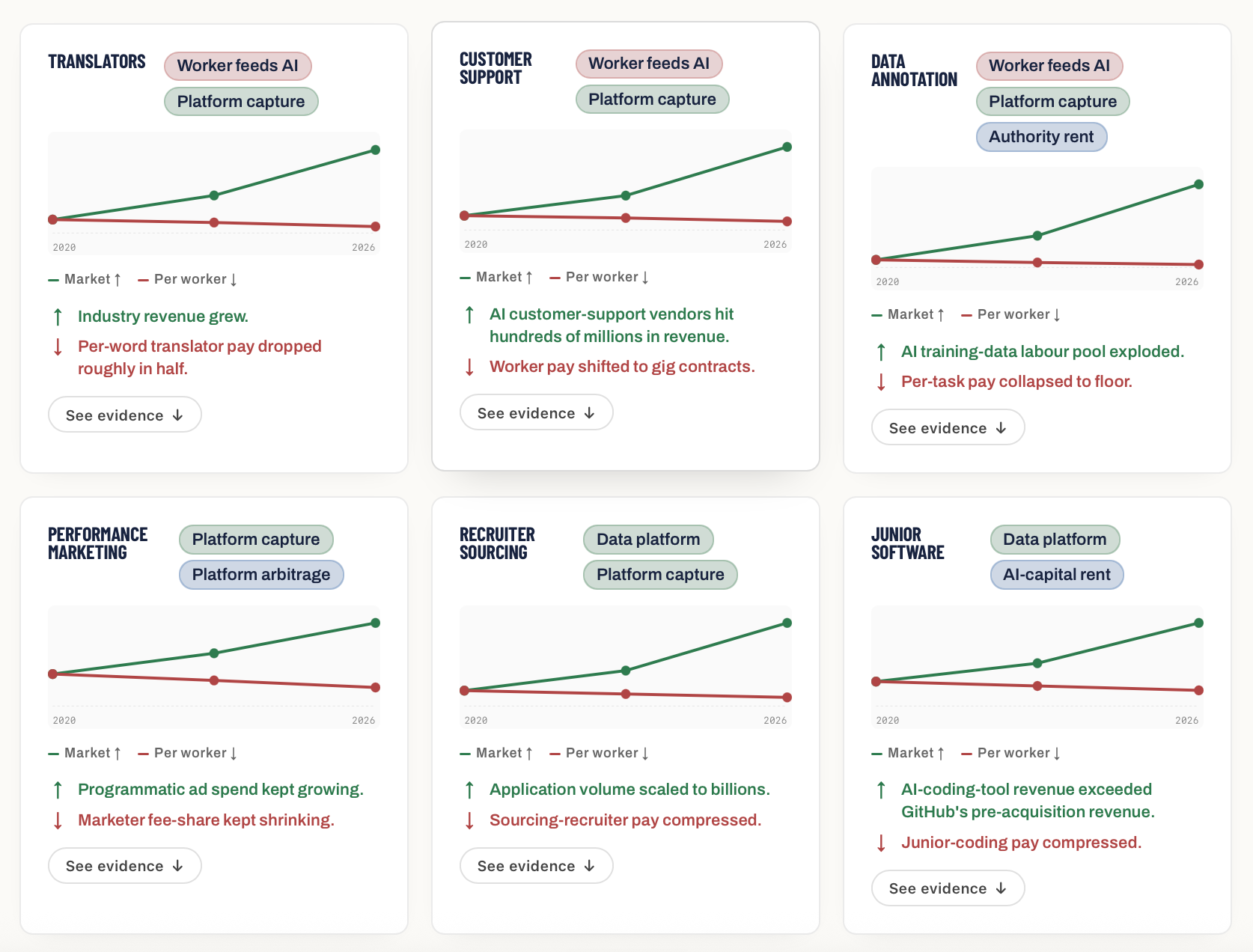
But instead of sharing it on the newsletter, I’m going to do one better.
You can play with the data and the argument at this deep-dive on Jevons Misunderstanding that launches today.
The argument architecture revisited
The Jevons Misunderstanding page is an example of a different publishing architecture.
The written word as a default mode of communication is rapidly getting commoditized. That does not mean all writing becomes worthless. It means the purpose of writing gets unbundled.
Jevons Paradox explains why efficiency can expand demand,
but it does not explain who captures the expanded demand.
The old newsletter version of this idea would be a linear essay. It would explain the analogy, cite a few sources, and end with a conclusion.
The new version uses prose to frame the argument, but adds the cases - in a way that you can play around with them - to illustrate the argument.
The page shows the popular claim, the historical analogy, the counterfactual, the role-level details, the capture stack, the mechanisms, the falsifiers, and the positions through which workers might actually benefit from the expansion.
The reader is invited to inspect the architecture of the claim.
This is my attempt to disrupt this newsletter and move to an AI-native format.
Over the past few months, I've been building several indices to prove out the Reshuffle thesis. While there's a treasure-trove of data now loaded onto the underlying indices, this analysis, titled Jevons Misunderstanding, launching today, is the first application of the index that I'm putting out there.
This page is built on the index. And as the index continues to be trained on a monthly basis, all pages built on it refresh automatically with new data, providing a constantly updated dashboard on these ideas. As and when the data flips to contradict the older read of the page, a periodically scheduled agent brings that up for review - even as the pages that grow around the index keep increasing.
I’d love to hear your thoughts and reactions.
And there’s a lot more where this came from!
The old newsletter was the argument.
The new newsletter is the interface to the argument system.
this reframes the whole debate. the standard Jevons pushback always assumes the existing production system scales when demand grows, which made sense for coal and steam but falls apart when the technology can rebuild the production system from scratch. steam made the weaver faster. AI learns what the weaver knows and eventually cuts the weaver out of the negotiation.
what stuck with me is the point about workers sitting above or below the algorithm. because historically thats always how technology transitions play out. the surplus grows, capital takes it first, and labour only gets a share decades later after enough institutional pressure builds. but this time the mechanism you describe, codifying tacit knowledge and separating workers from customers, actually removes the leverage that forced redistribution in previous rounds. so the share might not just arrive late. it might not arrive at all.
honestly the question was never whether AI grows the pie. its who holds the knife.
Great point, demand can expand and workers can still lose bargaining power if the algorithm captures most of the value. I’ve been thinking about a related idea, jobs with shorter feedback loops seem much easier to automate because they’re easier to optimize continuously.
Wrote a short essay on this here: https://manasbihani.substack.com/p/the-speed-of-being-wrong
Would love to know your thoughts.