
How to reimagine your work in the age of AI
How to unbundle and rebundle a book, a newsletter, or your next deliverable

I’ve been quiet here for quite some time.
I started noodling with a question towards the end of last year - what should work look like now that producing work is no longer a constraint?
More broadly, what should AI-native work look like? And how can all of us - who’ve built careers around producing hard-to-produce outputs reimagine our work in an age when producing outputs isn’t all that hard anymore?
But before we get into all that, I’d like to start by launching something I’ve been working on over the past few weeks.
Launching: The living companion to Reshuffle
Many of you have enjoyed reading my book Reshuffle.
I’m delighted to announce the launch of the companion guide to Reshuffle.
In the book, I had mentioned that I would be launching a companion guide to Reshuffle in early 2026.
When I started working on it, I originally imagined it as another book. But as I went further down that path, I realized that a book was not necessarily the right format for what I wanted to build.
Books remain an extraordinary medium for communicating a big idea in a persuasive, structured way. Reshuffle itself was written for that purpose. But in the age of AI, many ideas need to be encountered differently. Some need to be explored, queried, recombined, navigated, and applied. They need interaction, not just exposition.
The book - I believe - needs to be unbundled and rebundled.
That realization led me to rethink the companion guide. Instead of turning it into a static book, I have launched it as an interactive artifact — a living companion to Reshuffle.
For now, it has three core components, and I expect it to keep expanding over time.
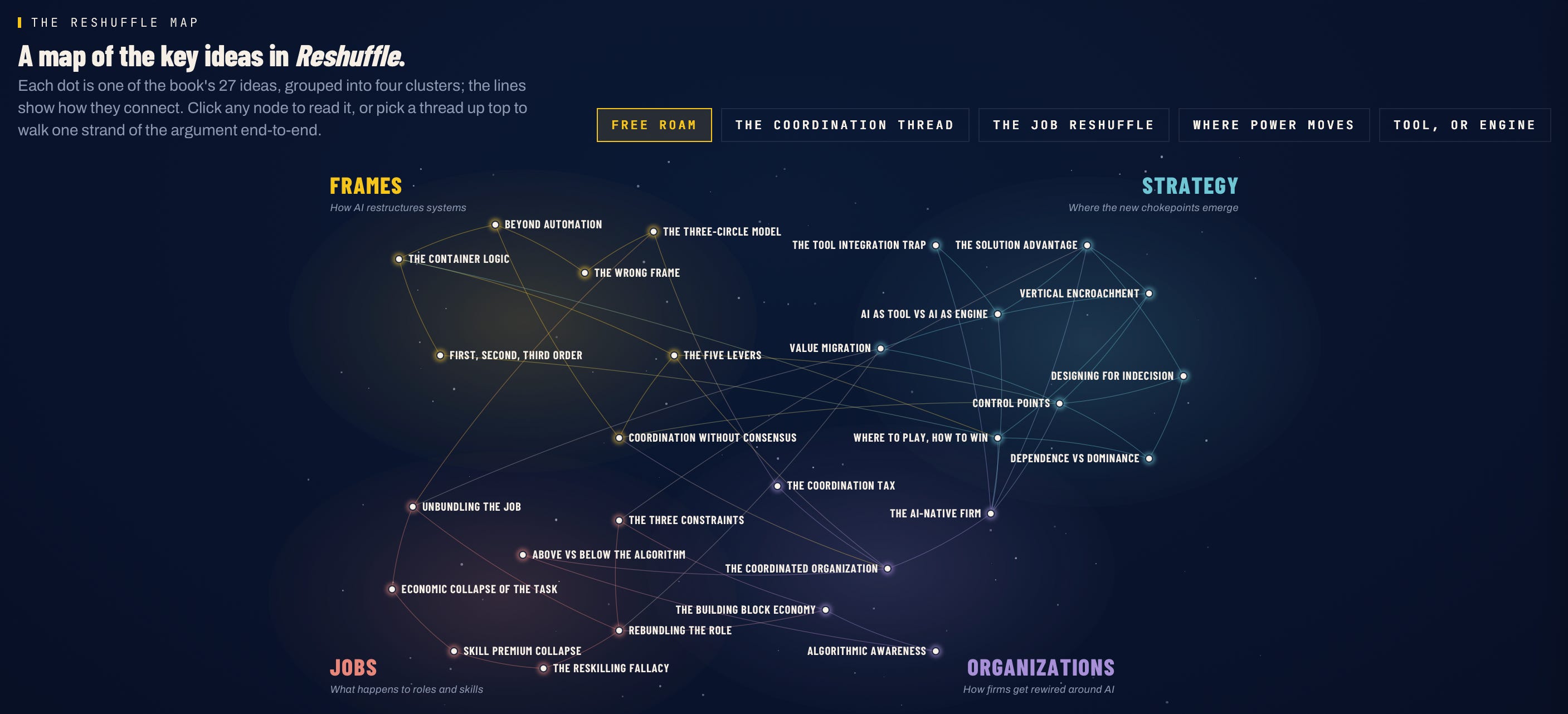
First, and most important, you can work through the ideas in the book using the Reshuffle Map that maps out the core concepts and how they connect to each other.
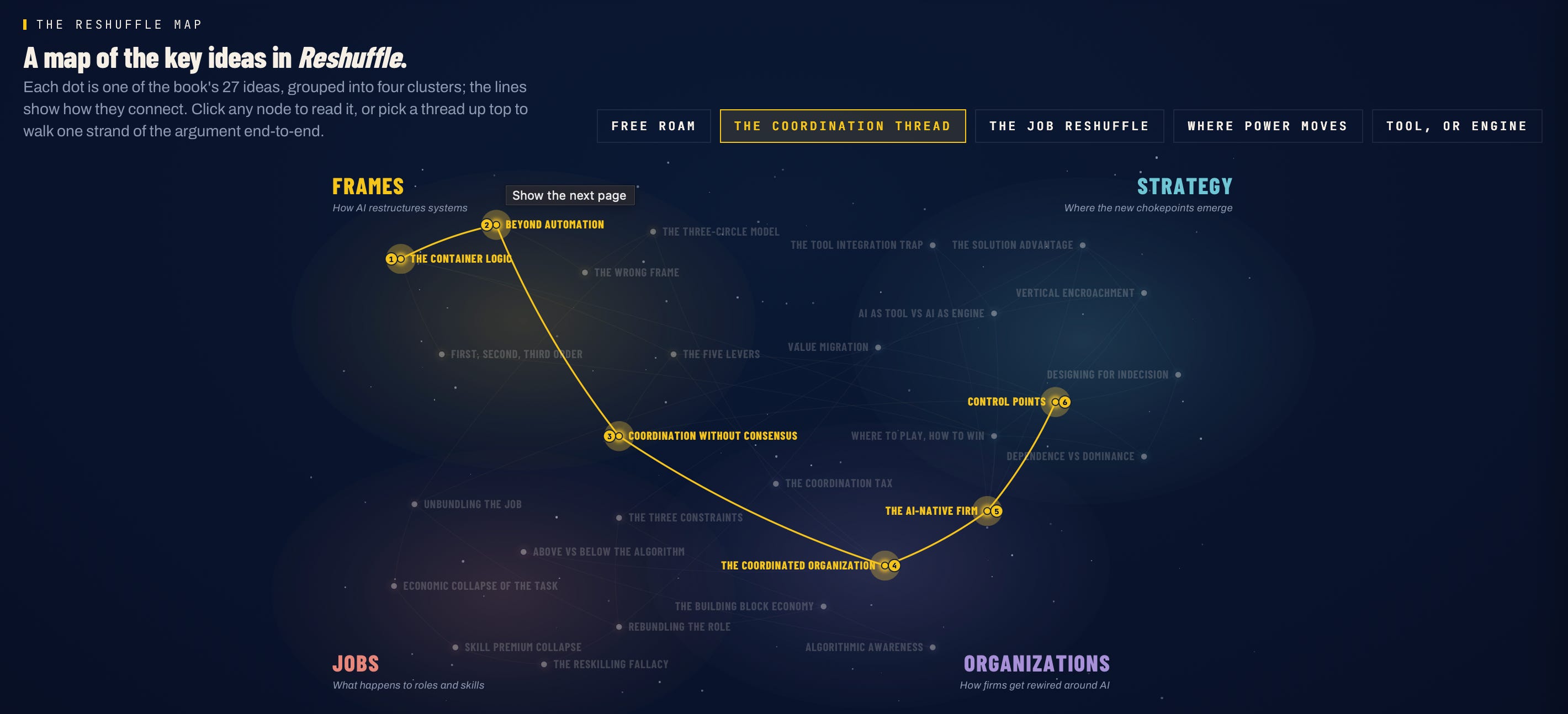
You can explore specific threads/paths on the map. For instance, the coordination thread:
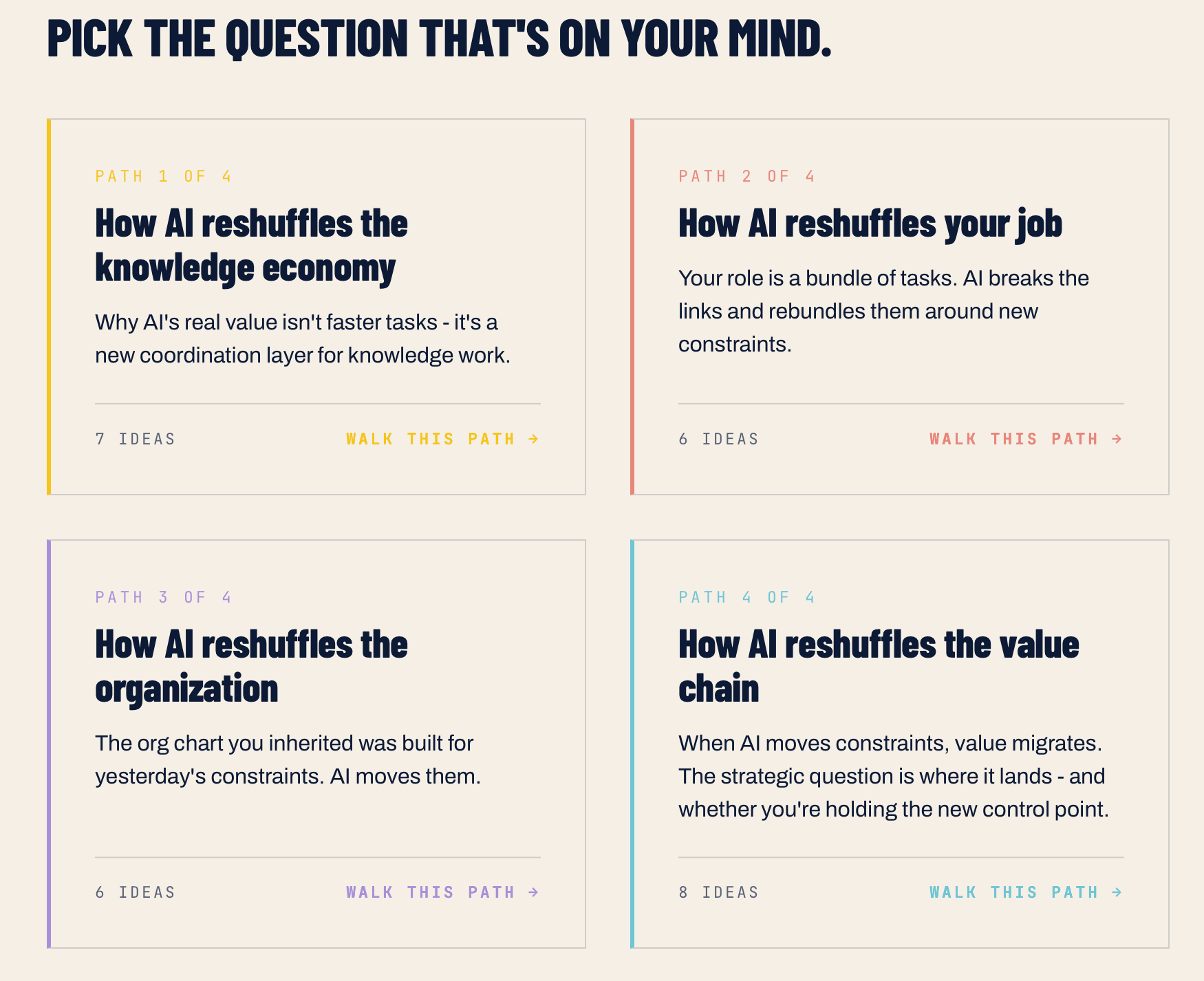
Or you can work through one of the four pathways through the book - which talks about AI’s impact at all 4 levels - jobs, orgs, ecosystems, and the larger economy.
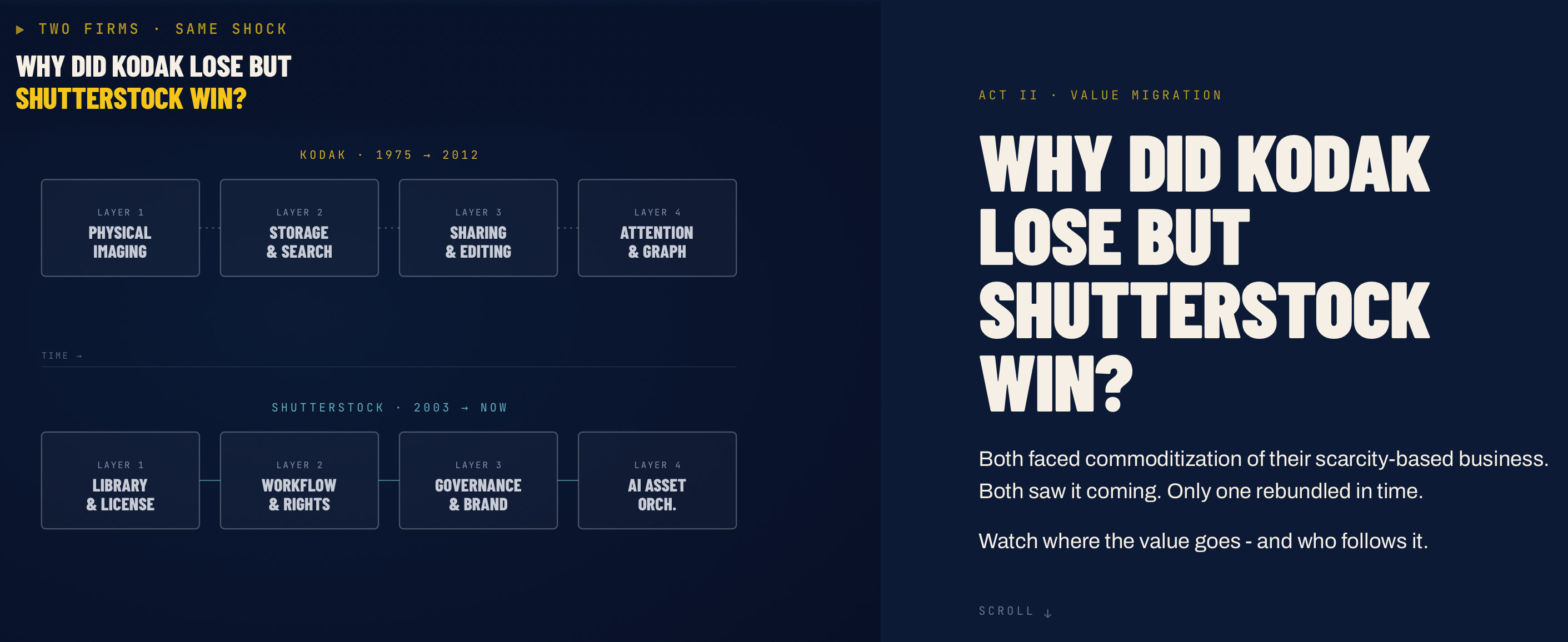
And finally, if you’re just looking to scroll around, you can work through the central scrolly-telling narrative:
Have fun poking around the site, and let me know if you’d like to see anything specific in the comments below.
The AI-native book/newsletter:
Unbundling and rebundling a book/newsletter
This brings us back to a central question:
How should we reimagine our work in the age of AI?
For most of the knowledge economy, we have evaluated knowledge work through its outputs. We judged the report, the spreadsheet, the program, the design, the presentation, the book, the newsletter. These artifacts became the visible proof of the work.
But that created a subtle distortion. We began to overvalue the artifact itself and undervalue the problem the artifact was meant to solve. A book, for example, is valuable because it helps a reader understand, believe, remember, apply, or share an idea. A newsletter is valuable because it creates rhythm, attention, and connection around a set of ideas.
And yet, the artefacts themselves may not be the best solution to the problem that they’ve been built to solve
AI exposes this distinction because it makes artifacts easier to produce, with far less friction. When output becomes abundant, a polished artifact isn’t as valuable anymore.
What’s more valuable is understanding what job needs to be done and what form the idea should take to do that job well.
That shift changes the nature of knowledge work. Value moves from producing a single finished output to designing a system through which ideas can be structured, recombined, and expressed in different forms for different purposes. The same underlying ideas may need to become a book chapter, a map, a visual, a decision tool, or an interactive companion.
So the real work is no longer artifact production. What matters more is idea architecture. It is understanding the job an idea needs to perform, unbundling it into reusable components, and building mechanisms that allow those components to be rebundled towards the right output for the right context.
In a world where outputs can be created on demand, the scarce skill is not merely making the output. It is knowing what the output is for and owning the unbundling and rebundling logic to get it there.
Let’s take the Reshuffle companion. It is, by no means, a fully evolved solution, but it does two things that you’ll instantly see.
It unbundles the book into its core component ideas.
It then allows different forms of rebundling to bring those ideas back to life in new ways.
The map is one example of the rebundling.
The pathways are another.
Once you look thorugh those pages, you’ll see that both of them are different bundles of the same underlying components.
The book, for that matter, is itself a specific bundle of those ideas, tied together with a specific narrative style to aim a certain transformation for the reader.
Now, once the reader has read the book, it may no longer serve as the optimal artefact for what the reader next needs i.e. reference the ideas, apply them, build on them etc.
This is where creating a reusable idea architecutre - by unbundling and rebundling the book - helps.
Reimagining the unit of work in the age of AI
What does it actually mean to produce AI-native work?
Most people answer that question by reaching for AI as a tool. They use it to summarize a book, turn a keynote into a carousel, the carousel into a thread, the thread into a podcast, the podcast back into a blog post.
They get faster. They get into more channels. They feel productive.
They are doing exactly what Adobe did when the cloud arrived: same file, new pipe.
This is repurposing. It feels like transformation but it changes nothing structural. It is still built on the logic of the output, much like Adobe was built on the logic of the file.
Figma did not put the design file on the cloud like Adobe. Figma killed the logic of the file. From the article:
It replaced the file with the element - a button, icon, or type style - as the basic unit of work.
Because of the element-based architecture, Figma users could create shared libraries of reusable design components, like buttons, icons, type styles, and color palettes, that teams could use across multiple files and projects. Instead of duplicating these elements in each file, designers simply reference a single source of truth.
The ‘file’ was now a specific rebundling of these elements, not a siloed disconnected object.
Changes and permissions could be tracked and managed at the level of a design element. Each element was addressable in a database: change a component once and that change propagated everywhere it appeared.
This creates consistency, simplifies updates (change once, update everywhere), and enables cross-functional teams to work with aligned visual standards. Shared libraries shift design from isolated file ownership to coordinated, system-level collaboration.
By shifting the unit of work from file to element, Figma enabled real‑time collaboration, created a shared design environment that expanded who could participate, and made Adobe’s model feel increasingly constrained by its own architecture.
The Figma move and the Adobe move sound similar from a distance. They are opposites. One moves the same frozen artifact through new channels. The other unbundles the artifact and lets new artifacts emerge from new rebundlings.
Adobe’s move is a distribution story. Figma’s move is an architecture story.
Why the written form was always a workaround
Every output we produce - the book, the report, the deck, the course - is a bundle. Inside any one of them: frameworks, claims, examples, evidence, counterarguments, definitions, stories, decisions. What fuses the bundle is the narrative - a single chosen ordering of those ideas.
Yet, the narrative is one of many bundling logics meant to solve a specific problem.
Ideas in your head are associative. You hold one concept and a dozen related ones hang off it at once - examples, exceptions, counterweights, applications. No writing technology has ever been able to transmit that directly. So the author compresses an associative web of related ideas into a single chosen line, discarding every other ordering that could have worked, because there was nowhere to put the leftovers. Then the reader decompresses, rebuilding the associations in their head from the one path they were given.
Effectively, the book is a lossy representation sitting between the author’s understanding and the reader’s reconstruction.
Once you can see the linear artifact - whether a book or a spreadsheet or a product design doc - as a property of the medium rather than of the thought, you have a path to making the Adobe-to-Figma move.
Unbundling, then rebundling
There are two distinct moves here.
Unbundling is the recognition that the output is not the unit. You stop thinking of the book (or any artefacts/output) as a thing to be sliced into formats and start thinking of the ideas inside it as items that have their own life. You stop asking “how do I get more out of the book” and start asking “what are the actual ideas I have, and what could each of them be in their own right.”
This is not something as pedestrian as content repurposing, which is the Adobe move - still taking the output as the unit of work and repurposing it for a new channel.
Rebundling is what becomes possible once you’ve unbundled: combinations the original sequence could never have expressed. New compositions for new contexts, new audiences, new questions. The expression of each idea is now a function of the context it is being delivered into.
Repurposing leaves the bundle intact and changes the wrapper. Unbundling and rebundling changes the bundle itself — and once you can do that, you can do it again, and again, in response to questions the original output never anticipated.
This is not artifact repurposing. It is interrelationship-between-the-ideas repurposing. The thing you reuse is no longer the output; it is the connective tissue between the ideas, and yesterday’s output was only one way of packaging that.
Super-charging the ideas economy
This has massive implications that extend far beyond what you can do with a book, a newsletter, or any artefact you create.
Let’s take the example of the book again.
Since back in 2012, when I first began taking my research and writing seriously, I have documented almost every idea I came across. This was largely for my own research discipline - to put everything in one place and find connections between ideas that, at first glance, seemed unrelated.
For most of that time, the process was entirely manual. I used Workflowy as my main knowledge base. There were more sophisticated mapping tools available, but I found most of them too complex for daily use. Workflowy worked because it looked and felt close enough to Microsoft Word, while still giving me the flexibility to move entire chunks of thought into new hierarchies.
Here’s what a segment of my Workflowy looks like:
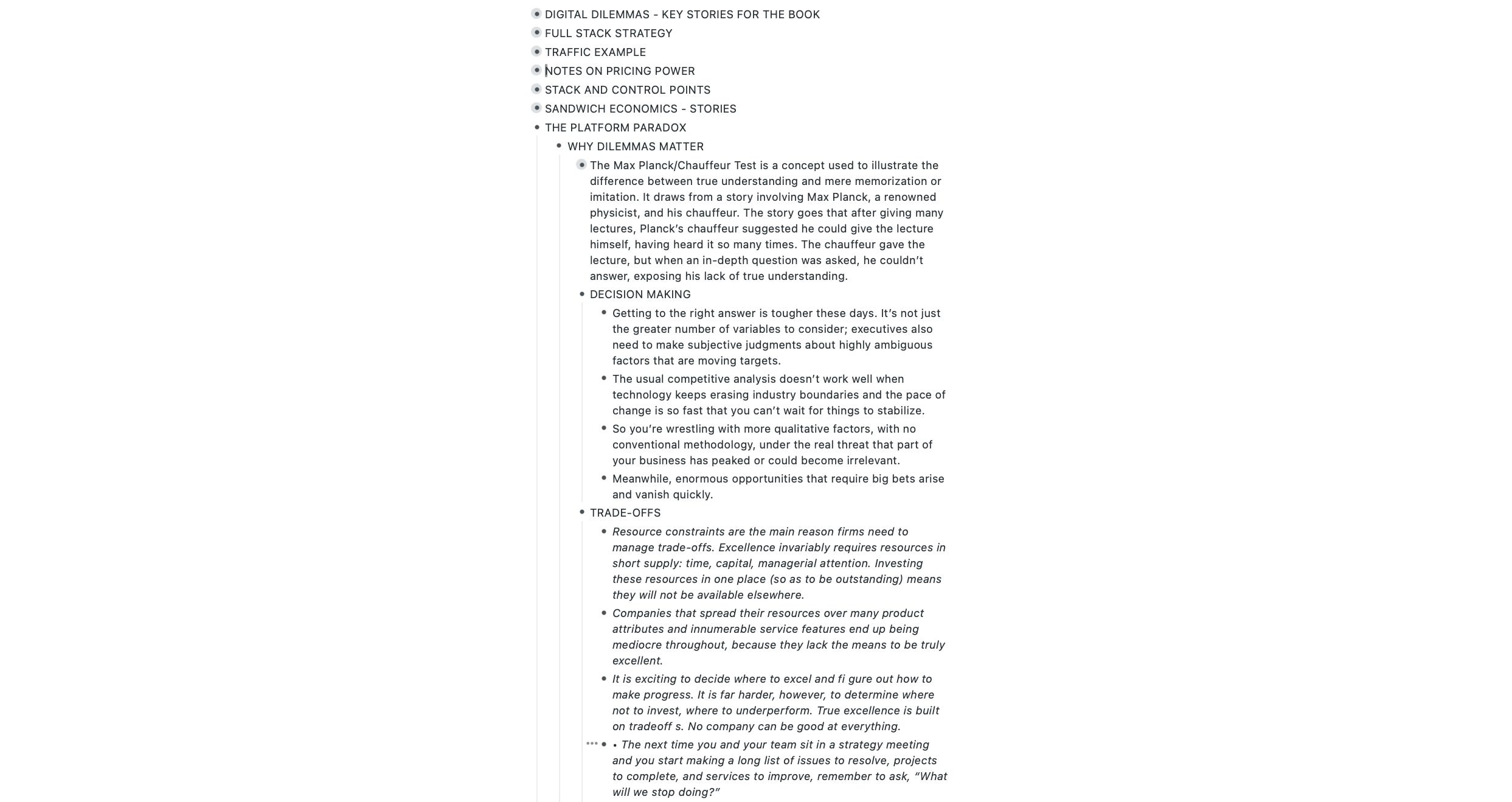
At an average of 25-30 ideas added everyday across an average of 300 days a year for the past ~15 years, this has been built out to a corpus of more than 100,000 ideas that have been documented over this time. I say more than 100,000 becuase on days when I really get lost into a topic, I easily add 100-150 components in there.
Yet, only a tiny sliver of all this corpus made it through in books and newsletters.
More importantly, my ability to identify combinations and causalities across these ideas was constrained not just by my cognitive bandwidth but more importantly by the growing manual effort in recategorizing ideas and restructuring hierarchies as I added more ideas here.
Here’s how I’ve managed it over the past 15 years:
Every day, I would add what I was reading, along with the relevant links, into Workflowy. Every so often, I would go back and clean it up. And every December, I would take the last 2 weeks to review the year’s notes, reorganize them, and merge them with the ideas I had collected in previous years. The fact that I was usually at a beach resort with nothing to do but marinate in all the ideas through the year made it an annual ritual I’d look forward to.
That system served me extremely well. It helped me write three books. More importantly, it helped me keep seeing connections between everything I was reading, studying, and thinking about.
But I now realize that a knowledge base like this becomes valuable only if it can be activated. If it simply sits there as a large archive, its usefulness is limited.
This is where GenAI becomes especially interesting.
Because it can interpret language, identify concepts, and make connections between them, it can help turn a largely tacit body of work into something more modular, searchable, and generative.
Over the years, every post, essay, newsletter, and book chapter I have written has essentially been a narrative effort to connect ideas that had already made it to my Workflowy. Much of that work has happened tacitly - as it does for most knowledge workers. But with GenAI, there is now an opportunity to make those underlying concepts, connections, and patterns more explicit.
In many ways, this is an extension of what I have been thinking about since I began writing Reshuffle: the componentization of knowledge, the modularization of ideas, and the falling cost of translation between previously disconnected silos.
I have long been interested in how these shifts apply not only to industries and organizations, but also to the world of ideas, concepts, and theories.
Over the last several weeks/months, I have been experimenting with a range of tools, primarily Claude Code, but also a few tagging and taxonomy management systems, to organize and restructure my knowledge base. The larger ambition is not simply to create a better archive, but to build a living system that can identify connections, recombine ideas, and help me work across the full depth of what I have collected over more than a decade.
And in that process, I’d like to keep rebundling these concepts into fundamentally new bundles for readers and consumers of these ideas.
Narrative formats like the book and newsletter will continue to play a role where they add the most value. But there’s a lot more that can be achieved with the idea architecture in place.
What’s next!
If you’ve found this approach compelling, I’d love to hear how you’re applying it in your work (or intend to apply it).
For now, the next ‘rebundling’ that I’m working on is a jobs index - a product that takes data from the market and applies the Reshuffle thesis to it to determine the extent to which specific jobs are being reshuffled.
The first index will launch next week - stay tuned for more!
And once again, don’t forget to give this a spin…
I have found your piece illuminating. Thank you. By a lucky coincidence it was my first reading of the morning. Perfectly appropriate.
I have found your Adobe / Figma example really useful too.
The "Write Then Slice" Paradigm is something we need to abandon if we want our ideas to be really useful.
this re-imagination is spot on:
a. Peter Senge's - learning organization - now takes on a new life / new way to imagine, retain, re-use.
b. In terms of utility - 2 immediate use cases i. 'Strategic projects' have outputs that are interconnected yet have different audience and need to synthesize outputs per scope (tech, needs, partners, business case, resourcing, operating model, compliance), feedback, rules et al. over many weeks / execution lifecycle. Static outputs are difficult to iterate and are often out-of-step during the journey ii. 'Partnership models' with trusted providers also is increasingly agile and needs to be dynamic (scope, priority, resourcing, cost model). Often the selection is based on output (proposal), that has limited value over longer time frames.